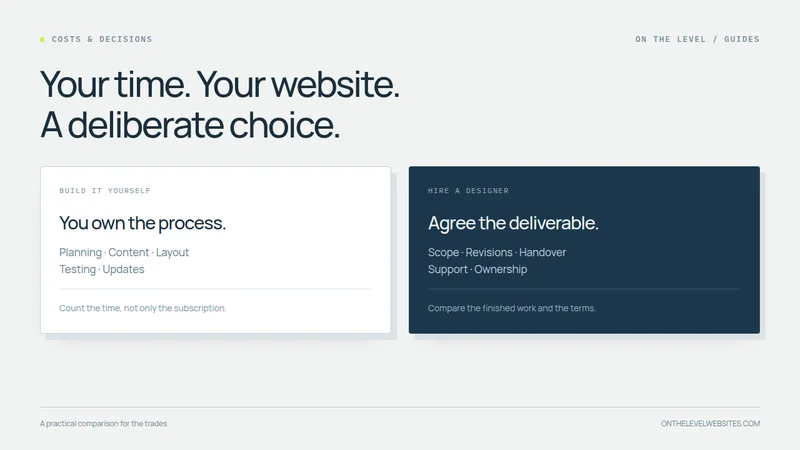
A website builder can be a useful tool. Hiring a designer can be a useful service. The choice is not whether one is universally professional and the other is universally cheap. It is who will do the planning, writing, organizing, checking, and maintenance—and whether that arrangement fits your business.
Start with the website you need, not a comparison of software logos. If you can clearly describe your services, choose photographs, learn the editor, and make time to finish the work, a do-it-yourself approach may suit you. If those jobs keep falling behind paid work, hiring someone can be the more practical option.
What you take on when you build it yourself
The editor is only part of the project. You still need to decide the page structure, write useful service information, prepare images, connect the domain, set up contact options, and check the result across devices. You also need to know what the platform includes and what requires an extra subscription or integration.
Templates can provide a starting layout. They do not decide which jobs you want, whether a project photograph is useful, or how much information a customer needs before making an enquiry. Those choices are business work, even when moving the elements around is straightforward.
Try a small, realistic test before committing. Build one service section and one contact section using your own wording and photographs. Open the result on your phone. If you enjoy the process and can keep moving, that is useful evidence. If it takes several evenings to reach a result you are comfortable showing, include that time in the decision.
What a designer should contribute
A designer should help turn the business information into a coherent customer journey, not merely move the same template blocks on your behalf. Ask how the work is scoped, how feedback is handled, and what the finished website will contain.
Look for a clear division of responsibility. You usually remain the source of accurate service details, genuine credentials, and permission to use project photographs. The designer can organize that material, develop the presentation, and test the implementation. A proposal should not make you guess who writes the copy or who will check the form.
Review the designer's examples for range and detail. Inspect the mobile navigation, typography, photograph treatment, and contact journey. A pleasing home-page screenshot is a starting point, not a complete test.
Compare cost over the same period
For a builder, identify the plan needed for your domain and required features, renewal prices, paid extensions, and what you expect to spend on your own time. For a designer, separate the design fee, hosting, domain registration, email, and optional ongoing work. Compare matching scopes and matching periods.
Here is a hypothetical time calculation, not an estimate of what you will earn: if a task consumes twenty hours and you assign your time an internal value of $40 an hour, the planning cost is $800 before subscription fees. That does not mean those twenty hours could definitely have been sold to customers. It simply makes your time visible instead of treating it as free.
Our standard new website is $697 paid in full at launch, with $37 monthly hosting separately. The six-payment option totals $837 for the design. A comparison should show those figures accurately rather than comparing our full service against another supplier's lowest advertised introductory amount. Our cost guide explains the scope.
Ask what happens if you leave
Check whether you can export the finished website, which content can be taken elsewhere, and whether a new provider could reproduce the setup. Do not assume that downloadable photographs and text are the same thing as a portable, functioning website. The answer varies by product and agreement.
Likewise, hiring a designer does not automatically mean every asset is exclusively owned by you. Fonts, stock media, software, and third-party services can have their own licenses or continuing conditions. Ask for the practical handover terms in writing: domain access, usable files, content, and account permissions.
Keep your domain under the business's control whichever route you choose. Our website ownership guide separates the address, files, assets, and subscriptions.
Do not buy a platform for a ranking promise
A platform choice is not a certificate of search visibility. Useful content, discoverable pages, and a sound implementation matter; simply publishing through a particular editor does not award a position in Google. Google advises evaluating whether content genuinely serves the intended audience. Its people-first content guidance is a better starting point than claims that a tool does all the marketing for you.
The same skepticism should apply to a designer promising guaranteed rankings. Ask what work is included and how it is checked, rather than treating technical labels as a sales result.
Choose a route you can maintain
DIY may fit when the site is simple, you like managing the details, and you have time to complete it. A designer may fit when the site matters now, you want help shaping the information, and you would rather have one person responsible for delivery. A hybrid can also work: professionally establish the site, then agree how future updates will be handled.
Choose based on the finished work and the ongoing arrangement, not pride in doing everything yourself or fear that only an expensive agency can build a useful website. The right solution is one you understand and can sustain.
A clear scope. A straightforward next step.
New websites $697. Redesigns $597. Nothing due up front. Standard hosting is $37 per month separately.
Let’s talk about your website