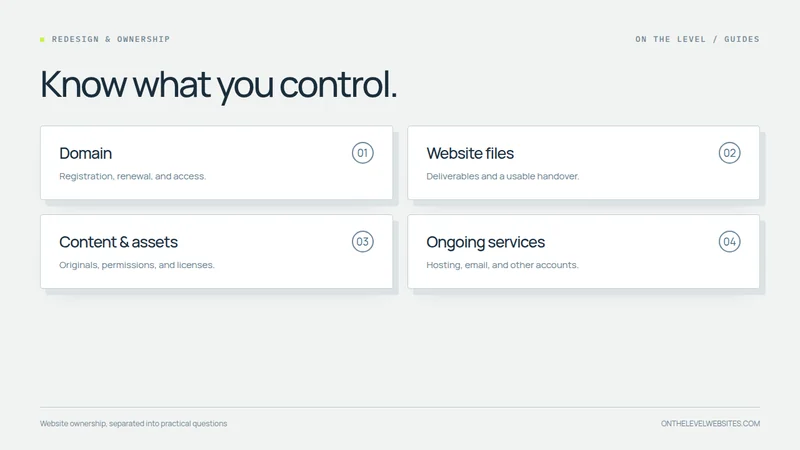
“The website is yours” sounds reassuring, but it leaves several practical questions unanswered. Does the business control the domain? Can the finished site be moved? Who holds the hosting and email accounts? Are the photographs and software licensed for the intended use? What happens if the person maintaining it stops responding?
Ownership and usable access are related, but they are not identical. The goal is to understand both before the business depends on the site. This is a practical purchasing checklist, not a legal determination about anyone's existing contract.
The domain is one asset, not the whole website
Your domain registration gives you an address under an agreement with a registrar. It is separate from the page design and the server that hosts the site. Keep accurate account and registration details, and know who handles renewal. If an agency registered the address for you, find out who is listed and what access or transfer process is available.
ICANN explains the role of the registered name holder and the rights and responsibilities attached to registration. Its guidance is a useful starting point when an account arrangement is unclear. See ICANN's registrant guidance.
Do not rely only on a receipt containing your business name. Confirm the operational details: login access, authorized contacts, renewal payment, recovery email, and security controls.
Ask for a usable handover, not an abstract promise
A practical handover explains what files, content, configuration, and access you receive. It should also explain anything that cannot be exported as a working site. Some services let you move content without transferring the underlying platform; others can provide a deployable set of website files. Check the actual arrangement.
Ask: “Could another provider run this website using the handover you supply?” If the answer depends on a paid license, a specific platform, or additional work, identify that before agreeing. A folder of images is not the same thing as the finished site, and an administrator password is not necessarily the same thing as a complete backup.
Content and third-party assets need their own explanation
Your business information, commissioned copy, project photographs, logo files, fonts, software, and stock media may have different origins and permissions. Do not assume the transfer of a website gives exclusive ownership of every component used in it. Ask which items are original work, which belong to you already, and which are supplied under third-party terms.
Keep the originals you are entitled to retain: logos, project photographs, written copy, and design deliverables. Keep records of permissions where they matter. If the site uses a subscription-dependent feature, know what happens when that subscription ends.
This is particularly important for photographs of completed jobs. The business should be able to explain whose work is shown and why it can publish the image. Our photography guide focuses on using the gallery as honest evidence rather than decoration.
Hosting is an ongoing service
Paying for the website design and paying for its hosting solve different problems. A completed site can belong to your business while still requiring an active hosting service to remain available at its address. Stopping payment for a host does not mean a replacement host appears automatically.
Find out how to request a backup or handover, whether there are any applicable notice requirements, and what support is included in a move. Keep those arrangements separate from assumptions about ownership. A useful exit plan identifies who supplies the files, who deploys them, and who changes the domain's destination.
Keep important accounts visible to the business
Domain registration, hosting, business email, analytics, forms, and business listings should have named responsibilities. A designer may need delegated access to do the work, but the business should understand the permission granted and the recovery process.
Use individual or delegated accounts where the service supports them rather than sharing one password among everyone. Record which supplier manages which service. When someone leaves, review their access instead of waiting for an account problem to force the issue.
| Part of the setup | Useful confirmation |
|---|---|
| Domain | Registrant, renewal responsibility, account access, and recovery arrangements |
| Website | Deliverables, transfer point, export format, and practical handover |
| Images and other assets | Who supplied them and what permissions apply |
| Hosting and email | Recurring charges, service owner, backups, and move process |
| Connected accounts | Business access, supplier permissions, and removal of old access |
Our ownership arrangement
At On the Level Websites, your domain remains yours. The completed website becomes yours once it is paid in full. Standard hosting is billed separately, and our published terms describe how you can request the files to move a paid-for website elsewhere. Your Google Business Profile remains under your ownership; where needed, we are added as a manager.
Read the service terms and your written agreement rather than relying on a headline alone. Extra functionality and third-party services can introduce their own conditions, so they should be identified in the agreed scope.
Resolve uncertainty before it becomes a migration emergency
If you already have a site and do not know who controls it, start with an inventory rather than canceling services. Ask the current provider for the relevant account and handover information. If the contractual position is disputed, get qualified advice before assuming access or rights you may not have.
Once the arrangement is clear, changing designers while keeping your domain becomes a practical planning task. The best time to establish that clarity is when the website is being commissioned, not when the business needs an urgent change.
A clear scope. A straightforward next step.
New websites $697. Redesigns $597. Nothing due up front. Standard hosting is $37 per month separately.
Let’s talk about your website