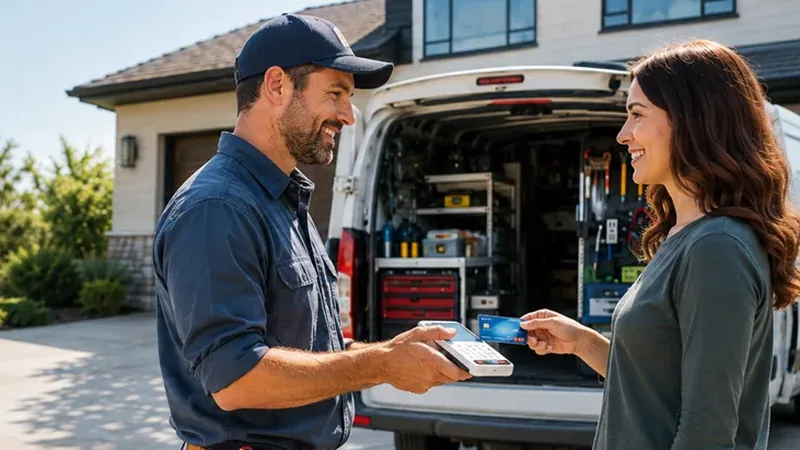
Accepting credit cards online isn’t something most guys rush into. Plenty of trade businesses run on cash and checks for years, and it works fine. Nobody’s saying you’re doing it wrong. But being able to take a credit or debit card online — through a link you can text or email — does three things cash and checks simply can’t: it signals you’re a real business, it opens up work from people who can’t hand you anything in person, and it gets money in your account in days instead of weeks.
This isn’t about becoming a tech company, and credit card processing for contractors has got a lot simpler than it used to be. You don’t need a merchant account in the old sense, a card reader, or a monthly bill. A payment processor handles all of it and takes a cut per job: it’s one link, sent by text, that a customer taps and pays. No card reader, no merchant account paperwork, no monthly minimum. Here’s why it’s worth the twenty minutes it takes to set up, what it costs, and the one setting almost nobody turns on.
It’s a credibility signal, same as the site itself
A customer sizing you up isn’t just looking at your website and your reviews. How you handle payment is part of that same impression, and it’s usually the last one they form before deciding whether to call you back.
“Cash or check only” reads as small and informal, fair or not. It’s the same instinct that makes a quote from mikeplumber55@gmail.com land differently than the same quote from mike@mikesplumbing.com. Nothing about the work changed. The signal did.
Being able to send someone a proper payment link, and have them pay by card in a few taps, reads exactly the way a professional website reads: this is an established business that’s done this before, not a side gig being run out of a truck bed. It’s the same reason the padlock in the browser bar matters — that doesn’t change the work either, but its absence costs you calls.
It opens up jobs you’d otherwise miss entirely
This one’s easy to overlook until it actually costs you a job. Think about who’s actually paying for the work:
- A homeowner’s adult kid, living three states away, paying for repairs on their aging parent’s house.
- A landlord who owns a rental in your town but lives somewhere else entirely — and there are a lot more of these than most guys assume.
- A family member covering a bill for someone after a storm, a fall, or a hospital stay.
- A property manager handling a dozen units who has no interest in mailing checks to a dozen different trades.
- An estate or an inherited house being cleaned up for sale by someone who’s never set foot in your county.
None of these people can hand you cash or drop off a check. For a good number of them, a card payment link is the only way that job gets paid at all — let alone paid without three phone calls and a two-week wait.
And here’s the part that stings: you usually never find out you lost these. They don’t call back and explain that paying you was too much hassle. They just quietly hire the guy who takes cards.
You get paid faster, with less chasing
A check has to be written, then mailed or dropped off, then deposited, then cleared. That’s days at best, and considerably longer if the customer is slow to get around to it. Meanwhile you’ve already paid for materials.
A card payment through a link is about as close to instant as it gets. You send the link when you finish the job, standing in the driveway. They tap a few buttons before you’ve loaded the truck. The money lands in your account within a couple of business days.
The bigger win is the cash flow, and the chasing you stop doing. Late payments are the thing that quietly strangles a small trade business — you’ve bought materials and paid your guys while a check sits on somebody’s kitchen counter. No follow-up texts. No “I put it in the mail last week.” No check that bounces two weeks after you’ve already spent the money. For most guys, the time saved not chasing payment is worth more than the processing fee costs.
Cash and checks aren’t going away, and there’s nothing wrong with taking them. But card payments are the difference between a job you can only get paid for in person, and a job you can get paid for from anywhere, the same day.
Check vs card vs bank transfer, side by side
There are three realistic ways to get paid for a job that isn’t cash. They’re good at different things, and most guys only ever use one of them.
| Check | Card | Bank transfer (ACH) | |
|---|---|---|---|
| Cost to you | Nothing | A percentage plus a few cents | Small percentage, usually capped |
| Speed | Days to weeks | Same day to send, days to land | A few business days |
| Works remotely | Barely — by mail | Yes, from anywhere | Yes, from anywhere |
| Can bounce or reverse | Yes, weeks later | Yes, via dispute | Rarely |
| Best for | Repeat local customers you trust | Most jobs, and anyone out of town | Big-ticket jobs |
The honest answer is that you want two of them available: cards for most work, and bank transfer for the big jobs. That combination covers almost everything without costing you much.
What accepting credit cards online actually costs
This is the part that stops most guys, so let’s put a real number on it. Payment processing costs a percentage of each payment plus a small fixed fee. The three names you’ll run into most are Stripe, Square and PayPal, and their headline rates are close enough that it isn’t worth agonising over. Stripe is one of the common ones, and it publishes its rates openly, which is more than you can say for a lot of payment companies.
At the time of writing, the standard US rate for an online card payment is 2.9% plus 30 cents, with no monthly fee and nothing to install. Check their current pricing before you rely on that number — rates move — but it’s been steady a long while and it’s roughly what the other big processors charge too.
What that means in practice, on jobs the size you actually run:
- $400 job — about $12 in fees. You keep $388.
- $1,200 job — about $35. You keep $1,165.
- $4,000 job — about $116.
On a small job that’s the cost of lunch. On a $4,000 job it’s real money, and that’s exactly where the next section matters.
The trick for big-ticket jobs
Almost nobody in the trades knows this one, and it’s worth actual money.
Alongside cards, most processors also let you take a direct bank transfer — you’ll see it called ACH. It’s slower than a card, a few business days rather than nearly instant, but the pricing works completely differently. Instead of a straight percentage, it’s a much smaller percentage with a hard cap. On Stripe that cap is currently $5.
The rule of thumb is simple: on anything above a few hundred dollars, offer the bank transfer option first and keep the card as the fast alternative. Most customers don’t care which one they use. You’re the only one who sees the difference.
This is the kind of thing that separates guys who treat payments as a cost from guys who treat it as something to manage. Over a year of big jobs it adds up to a serious number.
The four things guys worry about
“The fees eat my margin”
They’re a real cost, but run the comparison honestly. Against a check that takes three weeks and occasionally bounces, against the hours you spend chasing payment, and against the jobs you never got because the customer couldn’t pay you from out of state — the percentage usually looks cheap. And for the big jobs, the bank transfer route above mostly solves it.
Some trades add a surcharge to cover card fees. That’s legal in most states but the card networks have specific rules about how you disclose it, and a few states restrict it. If you’re going to do that, check your own state’s rules first rather than taking my word for it.
“My customers are older, they won’t use it”
Two things. First, the person paying often isn’t the person whose house it is — that’s the adult kid three states away, and they’d much rather tap a link than find a stamp. Second, taking cards doesn’t mean refusing checks. You’re adding an option, not removing one.
“What about chargebacks?”
A customer can dispute a card payment, and if they do, you’ll pay a dispute fee whether you win or lose. In the trades this is rare, and the defense is boring paperwork: a written quote they agreed to, photos of the finished work, and a clear description on the invoice. If you’re already photographing finished jobs, you’ve mostly done the work.
“Does this complicate my taxes?”
It makes them simpler, if anything. One thing to know: payment processors report your card volume to the IRS on a Form 1099-K once you pass a certain threshold, and that threshold has moved around a lot in recent years — ask whoever does your taxes what it is now. It isn’t extra tax, it’s the same income reported a different way. Every card payment is recorded automatically with a date and amount, which is a good deal easier at year end than reconstructing a year of cash and check deposits from memory. Talk to whoever does your taxes about your own situation, but the record-keeping is a point in favor, not against.
How to accept credit card payments: the actual steps
Setting up card payments doesn’t require becoming a tech company, and it doesn’t require a website that takes payments directly. Modern processors let any small business accept cards through a simple link, with no code and no big setup process.
The short version:
- Open an account with a processor. You’ll need your business details, your EIN or SSN, and a bank account for the money to land in.
- Turn on bank transfer as well as cards — it’s a toggle, and it’s the thing that saves you money on big jobs.
- Create a payment link you can reuse, or generate one per job with the amount filled in.
- Text it when you finish the job, while you’re still standing there. That’s when people pay fastest.
The same link works for a deposit before you start, a progress payment part-way through a big job, and the balance at the end. For anything running more than a few days, getting the deposit paid by card before you buy materials is worth more than the fee costs you.
That’s genuinely it. The whole thing takes about twenty minutes, and most of that is typing in your business details. Accepting credit cards online used to mean a merchant account, a terminal and a monthly bill whether you used it or not. That hasn’t been true for years.
What you’ll want ready before you start
- Your business name exactly as it’s registered.
- Your EIN, or your SSN if you’re a sole proprietor.
- The bank account you want the money landing in — routing and account number.
- A rough idea of your average job size, which is all they ask for.
Approval is usually immediate for a straightforward trade business. You can send your first payment link the same afternoon.
Make your next first impression a better one.
New websites $697. Redesigns $597. Nothing due up front. Standard hosting is $37 per month separately.
Let’s talk about your website