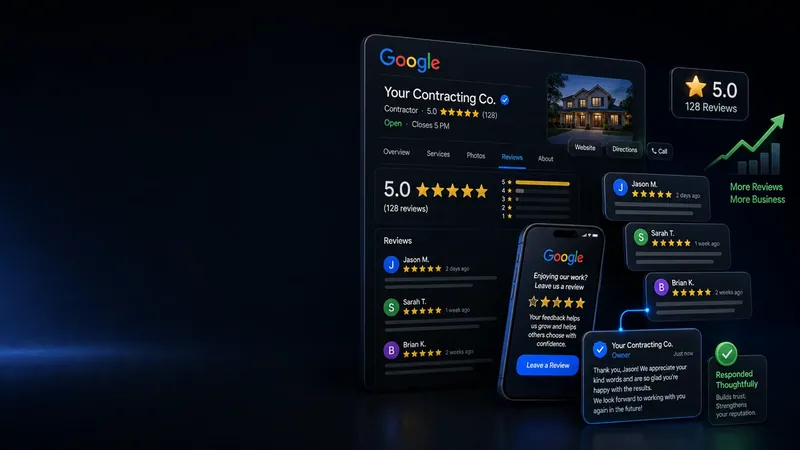
How to get Google reviews for contractors isn’t complicated, but most guys never actually do it — not because it’s hard, but because there’s no system. This is that system: when to ask, exactly what to say, what to avoid, and how to respond once the reviews start coming in.
Why this matters more than most guys think
Understanding how to get Google reviews for contractors starts with understanding why they matter. Reviews aren’t just social proof anymore — they’re one of the clearest signals Google uses to decide who shows up first in local search. A business with 150 reviews and a 4.8 rating will typically outrank a business with 12 reviews and a perfect 5.0. Volume matters, and so does recency: a profile that’s been getting steady new reviews looks active to Google, while one that’s been sitting at the same count for a year looks stalled, even with a great rating.
For a homeowner, reviews do something a website alone can’t. They’re about to let a stranger into their house and spend real money on work they can’t fully judge themselves. Reviews are how they decide whether to trust you before you ever pick up the phone.
When to ask
Timing is most of the battle. The best moment is right at the end of the job — the final walkthrough, when the customer is looking at the finished work and feeling good about it. That window of goodwill closes fast. Wait a week and send a follow-up email, and the moment’s gone; the customer’s moved on mentally even if the work was great.
How to actually ask
Make it as close to one tap as possible. A direct link straight to your Google review form — not your homepage, not a contact page — removes almost every excuse not to do it. You can generate this link straight from your Google Business Profile dashboard, or from a QR code you hand over on the spot.
A simple script works better than an elaborate one:
Text messaging tends to outperform email for this — it’s read faster, and the tap-to-review link works the same way it would from a QR code. Ask every customer, not just the ones you’re sure are thrilled — which leads into the one thing that gets accounts suspended.
What not to do
Google’s own policy on prohibited and restricted content is explicit about two things that feel like common sense but will get a profile penalized:
- Review gating. Asking only the customers you’re confident were happy, while quietly skipping the ones who weren’t, is against Google’s rules — not just bad practice. Every customer gets the same ask, every time.
- Incentivizing reviews. Offering a discount, a gift card, or anything of value in exchange for a review — even a review with no rating specified — violates Google’s policy and can get reviews removed or a profile suspended.
The version that actually works is simpler than either of those: ask everyone, every time, with no strings attached. It’s also the version that survives an audit.
Responding to positive reviews
A short, specific reply beats a generic “thanks!” every time. Thank the reviewer by name, mention something specific from what they wrote, and keep it under a few sentences. It shows future customers reading the review that a real person runs this business and pays attention.
Responding to negative reviews
This is the one most guys avoid, and it’s the one that matters most. A calm, professional response to a bad review often does more for your reputation than the review itself does damage — a future customer reading it sees how you handle a problem, not just that a problem happened once.
The pattern that works: acknowledge the issue without getting defensive, avoid arguing in public, and offer a real next step — a phone call, a way to make it right. Never accuse the reviewer of lying in the reply itself, even if you believe that’s what happened; take it offline instead.
A single calm, professional response to a bad review can do more for how you’re perceived than a dozen five-star reviews with no replies at all.
How many, and how often
The last piece of how to get Google reviews for contractors is consistency, not volume. There’s no magic number, but steady beats stalled. A handful of new reviews every month, indefinitely, does more for local ranking than a burst of twenty reviews followed by silence for a year. Google reads consistency as a sign of an active, real business — which is exactly what it’s trying to identify.
Track it loosely: after a few months of consistently asking, you’ll have a sense of your real conversion rate — roughly what share of happy customers actually leave a review when asked properly. That number tells you whether the ask itself needs adjusting, or whether it’s simply a numbers game that improves with volume.
How to get Google reviews for contractors — quick answers
Can I offer a discount for a Google review?
No. Offering anything of value — a discount, a gift card, a free add-on — in exchange for a review violates Google’s policy, regardless of whether a rating is specified. It can get the review removed or the profile restricted.
What if a review is fake or from a competitor?
Flag it through the Google Business Profile dashboard using the spam/fake content category, with screenshots as documentation. Don’t argue with it publicly in a reply — that draws more attention to it than letting the flagging process work.
How we help with this
Review link & QR cards — $75. A direct link to your Google review form, plus a printed card with a QR code your crew can hand over on the spot — the one-tap system this whole guide is built around, ready to use on the next job.
Make your next first impression a better one.
New websites $697. Redesigns $597. Nothing due up front. Standard hosting is $37 per month separately.
Let’s talk about your website