
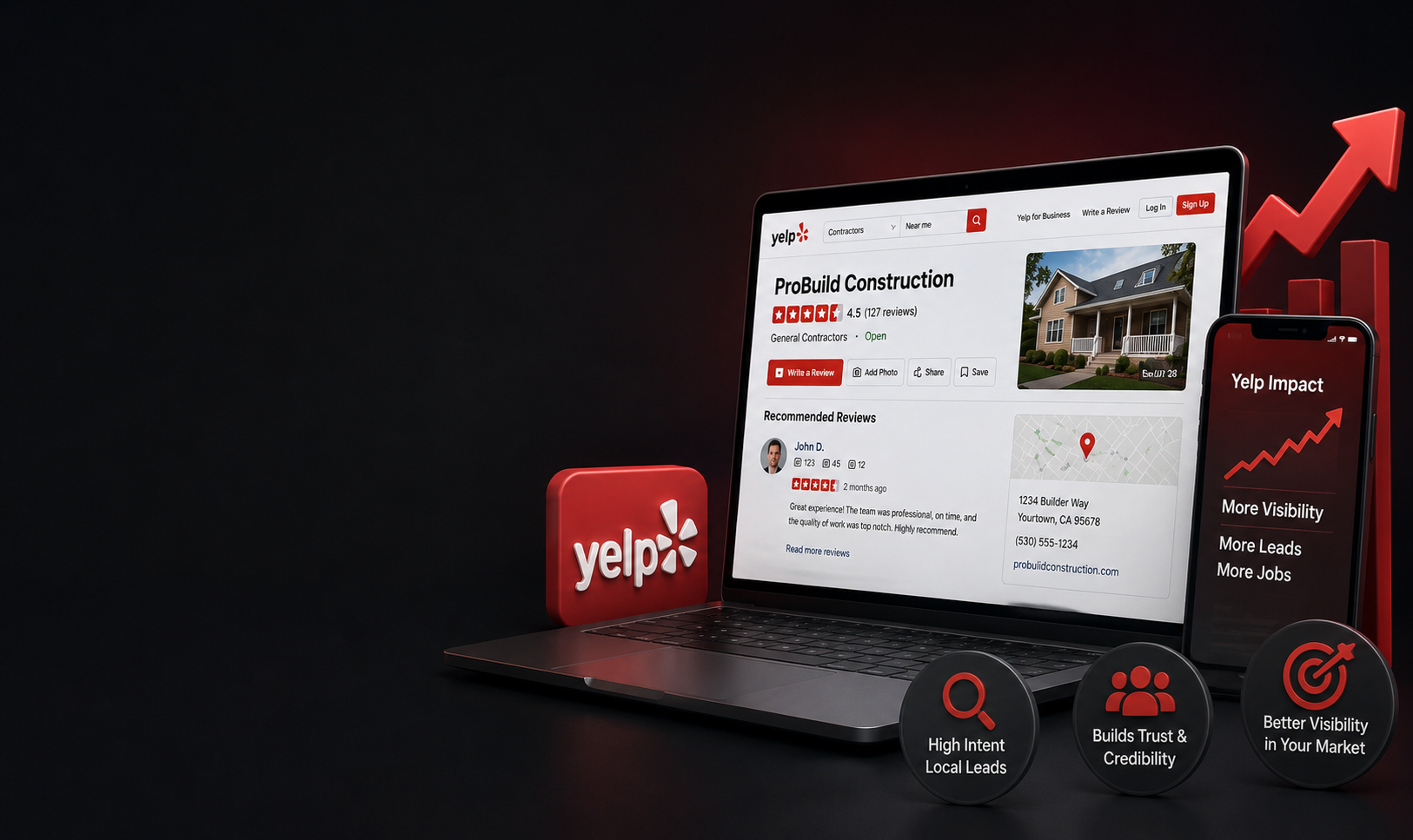
Is Yelp worth it for contractors? Plus Angi, Thumbtack, and Nextdoor
Is Yelp worth it for contractors? That’s the question behind every one of these calls. Every contractor gets the same ones — somebody from Yelp, somebody from a “local marketing” outfit, someone offering to get you to the “top of Google” for a flat monthly fee. Most of it’s the same pitch dressed up different ways: pay us, and customers will find you.
I’ve actually run these — not just heard the pitch. If you’re wondering is Yelp worth it for contractors, or Angi, or Thumbtack, here’s what each one really does and where the money actually goes.
Quick heads up before you read further: having a free listing on any of these isn’t the problem. It’s the paid ads on top of it that don’t pencil out. Keep that in mind as you go through each one.
Yelp
Yelp’s ad model is pay-per-click. You’re not paying for a customer, you’re paying every time someone clicks your listing — whether that click turns into a phone call or they just glance and move on. Yelp doesn’t publish a standard rate card, so what you pay depends on your trade, your market, and how competitive your category is. Home services tends to run on the higher end.
The bigger issue is what happens after you sign up. It’s a well-documented pattern: a sales rep gets you started, often with promises about trial periods or low initial spend, and then the recurring charges keep going — sometimes well past when someone tried to cancel. That’s not a rumor, it’s a pattern with enough of a paper trail that you can find it in complaint databases.
So is Yelp worth it for contractors? It can work, but you’re renting — and you’re renting from a landlord who doesn’t publish the rent.
Nextdoor
Nextdoor’s pitch is different — it leans on the neighborhood-trust angle, which is real. People do ask their neighbors for handyman recommendations. But the free version of a Nextdoor business page has limited reach. It shows up when someone happens to be scrolling and happens to see it, or when a neighbor specifically recommends you in a thread.
To get consistent visibility, you’re back to paying — Nextdoor sells ads that appear in the neighborhood feed, and you’re competing directly against every other local business posting that same day for the same eyeballs. It’s a feed, which means today’s post is tomorrow’s buried post.
Verdict: good for word-of-mouth on top of everything else. Not a replacement for anything — a supplement, and one you don’t control.
Angi (formerly Angie’s List)
Worth knowing up front: Angi and HomeAdvisor are the same company now — they merged years back, so a lot of what looks like “different” platforms is really one company with two brands and the same lead pool underneath.
Angi mostly runs on pay-per-lead: typically $15–$85 per lead, sometimes over $100 for bigger trades like roofing, HVAC, or remodeling. On top of that there’s commonly an annual membership fee, often around $300/year, just to participate. And it’s a shared lead — the same homeowner request usually goes out to somewhere between 3 and 8 contractors at once, so you’re bidding against a handful of guys for the same job, and you pay whether you win it or not.
The part that catches people is the contract. Angi commonly runs 12-month agreements with auto-renewal, and canceling early can cost 30–35% of what’s left on the contract, plus a notice period to get out. Once you’re in, it’s not a quick exit. Factor in the shared leads and no-shows, and the real cost per booked customer often lands well over $1,000 — a lot more than the per-lead sticker price makes it look like.
Verdict: same story as Yelp, with a contract bolted on. You’re renting, and there’s a penalty for trying to stop.
Thumbtack
Thumbtack works on a similar pay-per-lead model — typically $20–$75 per lead depending on trade and job size, sometimes $150+ for big-ticket work. No annual membership fee like Angi, which is one point in its favor. But each lead usually goes out to 4–5 contractors at once, and most homeowners hire whoever responds first — so on Thumbtack, how fast you answer your phone matters more than how good your work is.
The number that actually matters is cost per booked job, not cost per lead. Most contractors close somewhere between 10–25% of what they pay for, which means a $40 lead can easily turn into $200–$400 once you count the ones that went nowhere.
Verdict: more flexible than Angi — no annual lock-in — but the same core problem. You’re paying for a chance to quote, not a customer, and you’re racing other contractors to the phone.
Your own site + Google Business Profile
Here’s the number that makes this whole thing worth doing: Google handles roughly 90% of all search traffic worldwide, and around 85% in the U.S. specifically. When somebody grabs their phone and searches “[your trade] near me,” there’s about a 9 in 10 chance that search happens on Google — not Bing, not some AI chatbot, not a niche app. One platform, most of the searches. That’s exactly why your site and your Google Business Profile are built the way they are — the whole thing is set up specifically to rank on Google, because that’s where the people looking for you actually are.
Google’s map results (the “local pack”) pull from your Google Business Profile — for free. No bidding, no click charges, no sales rep. Getting that profile actually optimized (right categories, real photos, accurate service area, reviews) is what determines whether you show up in the first three results or get buried on page two — that’s the single highest-leverage thing a small trade business can do, and it costs nothing to maintain once it’s set up right.
Your website is what happens after that click. It’s the thing that turns “found you on Google” into “called you.” And unlike a platform listing, it’s yours — nobody can shut off your visibility because you missed a payment, and it doesn’t reset to zero. A site that’s been live for two years with real content on it generally outperforms a brand new one, because search engines reward things that have been around and stayed consistent. Every add-on you build later (more pages, a blog, more reviews) stacks on top of what’s already there instead of starting over.
Think about what a Craigslist post or a handwritten sign actually gets you: Craigslist-tier customers, Craigslist-tier budgets, Craigslist-tier trust. If a cheap classified ad is the only thing selling your business, you’re going to attract the guys shopping for the lowest bid — because that’s exactly what a Craigslist ad signals. A real website does the opposite. It signals you’re an established, legitimate business, and that brings in customers willing to pay what the work is actually worth instead of nickel-and-diming you before you’ve even shown up.
It’s 2026 — every legit business has a website by now. Not having one isn’t neutral anymore, it’s a red flag. A customer scrolling past you because you don’t show up online isn’t thinking “he’s just old school,” they’re thinking “can I actually trust this guy.” Fair or not, that’s the assumption you’re up against the second someone can’t find you.
Not having a website isn’t just a missed opportunity anymore — it’s actively holding you back. Every day without one is another day the guy down the road with a decent site gets the call that should’ve been yours.
One small piece that feeds into all of this: your site links out to your Facebook, Instagram, or YouTube if you’ve got them. Search engines treat those outbound links as another signal that you’re a real, active business — not a huge factor on its own, but it adds up with everything else. Worth being clear on how this works: you create and control those accounts, always. We’re not managing your social media or posting on your behalf — we just wire the links into the site so they’re doing their part for your visibility.
None of this is instant — but if you start now, you’ll see a steady uptick in business over the months ahead instead of still standing at zero a year from now wishing you’d started sooner.
Verdict: this is the one that compounds. Everything else is rented.
The smaller your town, the bigger this matters
Here’s something most guys don’t think about: in trades like handyman work, painting, and a lot of the smaller service businesses, plenty of companies — especially outside the bigger cities — still don’t have a website at all. They’re running on word-of-mouth, a Facebook page, or nothing but a phone number on the truck. That’s not a knock on them, it’s just how it’s always been done. But it means the bar to show up first on Google isn’t as high as you’d think.
In a big metro area, you might be competing against fifteen other guys who all have decent sites, active Google Business Profiles, and a stack of reviews. Outside that — smaller towns, rural service areas — the search results are often thin: a handful of businesses with no website, one or two running something outdated, and almost nobody actively working their Google profile. That’s not a hard field to get to the top of.
Simply having a real Google Business Profile, a legit website, and a handful of Google reviews can be the difference between being the invisible guy in the truck and being the name that shows up first when someone nearby searches “[your trade] near me.” You’re not outspending anyone — you’re just showing up when almost nobody else bothered to.
Reviews are the one part of this that’s genuinely on you to collect, and how you respond to them matters just as much as getting them. We’ve got a full breakdown — including exact examples of what to say — on the dedicated guide: Getting (and responding to) Google reviews the right way →
The guys who show up first usually aren’t the best at the trade — they’re just the ones who showed up online at all.
Side by side
Take the sales pitches out of it and just look at the numbers and the actual work involved:
| Yelp Ads | Nextdoor Ads | Site + Google Business | |
|---|---|---|---|
| Monthly cost | $300–$2,500+ | Varies, ongoing to stay visible | ~$37/mo hosting |
| Setup effort | Sales call, account setup, ongoing bid management | Profile setup, ongoing posting to stay visible | Built once, mostly hands-off after |
| What you own | Nothing — it’s their platform | Nothing — it’s their platform | The site, the content, the domain |
| Stop paying, then what? | Visibility stops immediately | Visibility stops immediately | Site and GBP stay up |
Cheaper to run, less to babysit, and you’re not one missed invoice away from disappearing. That’s the whole case in one table.
So is Yelp worth it for contractors, or should you drop these platforms?
The free listing on any of these? Keep it. Claim your profile, fill it out, let the reviews stack up — it costs nothing and it’s one more place someone might find you. That’s not the problem.
The problem is paying for placement on top of it. That’s where the math stops making sense — you’re paying rent every month on visibility that vanishes the second you stop, on a platform that shares your lead with three, five, sometimes eight other guys anyway. Free listing: smart. Writing them a monthly check: dumb, once you’ve got a site and a Google Business Profile of your own doing the same job for free.
Is Yelp worth it for contractors on the free tier? Sure. Paid tier, skip it. Get the thing you own working first — everything else is optional on top of it.
Is Yelp worth it for contractors in a small town?
Usually not. Yelp ads work best where there is already heavy browsing traffic on the platform, and in a smaller market that traffic is not there — people are searching Google or asking a neighbor. The same money goes a lot further getting your Google Business Profile right.
Is Yelp worth it for contractors who already rank on Google?
Even less. If you are already showing up in the local pack for your trade, Yelp ads are buying a second, weaker version of visibility you are getting for free.
So is Yelp worth it for contractors ever?
If your category genuinely gets browsed on Yelp, and the free listing, the site and the Google profile are all already working, then testing a small budget is a fair experiment. It is the wrong place to start, not a thing that never works for anybody.
How we help with this
This is the core of what we build — not an add-on, the actual product.
Standard 5-page site — $697 one-time (or $837 over 6 months, $0 down either way). Home, services & pricing, gallery, contact, and about — built and set up specifically to rank in Google, not just look good. Includes hosting and small fixes for $37/mo after launch.
Google Business Profile optimization — $150. Right categories, real photos, accurate service area, everything filled out the way Google actually rewards — this is the single highest-leverage thing a small trade business can do, and most guys never touch it.
SEO package — $150/mo. For once the basics are live and you want to push further: keyword-targeted page content, a monthly ranking report, and ongoing local listings work.
Ready to build the thing you actually own?
Fill out the quick form and we’ll have your plan figured out.
Get started